
Running a Sex Offender Check in Marion County
The official starting point is the West Virginia Sex Offender Registry. It covers releasable registrations maintained by the West Virginia State Police, including records tied to Marion County and Fairmont-area addresses. Begin with the clearest facts available, such as a full name, city, ZIP code, or known location. A broad name match needs more review because aliases, similar names, and changed addresses can affect results.
Marion County does not publish a separate verified sheriff registry map or registry-alert app. The state portal is the public West Virginia channel. The WVSP Registry Unit handles reported errors and suspected noncompliance, while the responsible WVSP detachment handles registrant reporting and verification. For a person who may have moved across state lines, the U.S. Department of Justice national search adds a second layer. Results from either source should be checked against the originating jurisdiction.
The official registry entry screen shows the gateway Marion County searchers must use.
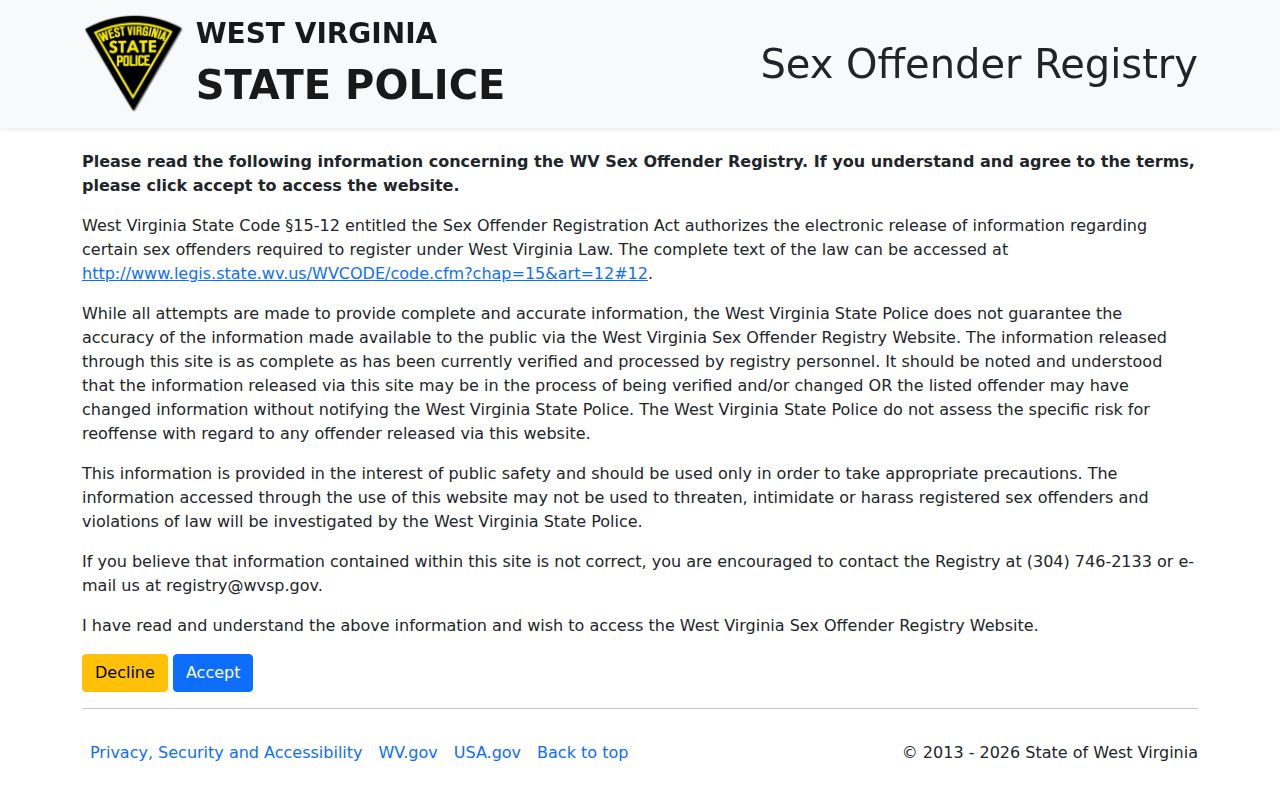
That gateway matters because the conditions of use and accuracy limits apply before any public profile is opened.
Marion County Registry Disclaimer Gate
The portal first asks the visitor to accept or decline its disclaimer. Accepting opens the search functions; declining exits. This is more than a routine click. WVSP says registry information can be under verification, can change, and can lag when a registrant fails to report new facts. It also says that listing someone is not an individualized finding that the person will commit another offense.
The WVSP registry disclaimer is the controlling source for those limits and for lawful conduct.
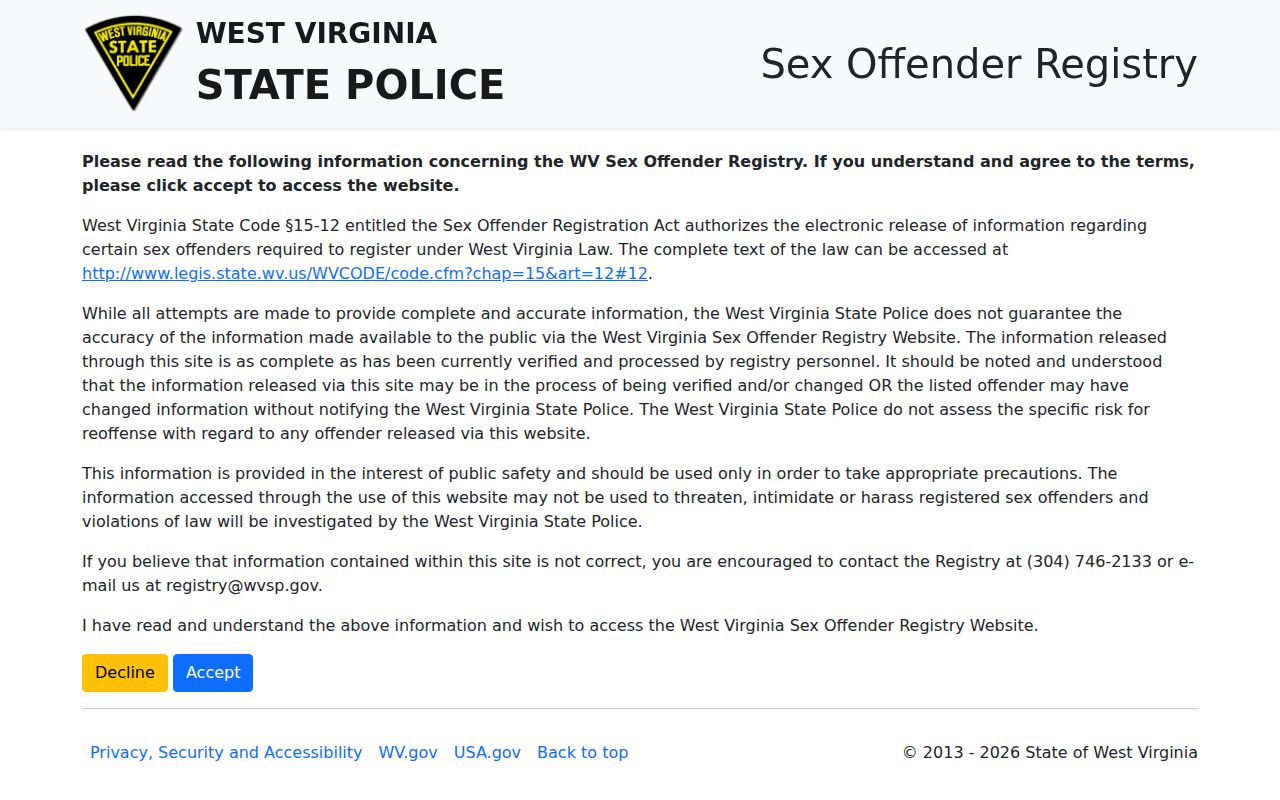
Reading it first helps a Marion County visitor separate a public notification record from a risk prediction or a complete criminal history.
Searching the West Virginia Sex Offender Registry
The West Virginia State Police runs the statewide portal under the West Virginia Sex Offender Registration Act. The public interface is free and session-gated. Search controls can change after the disclaimer is accepted, so use only the fields that the live form displays. The research verified name and geographic or advanced routes, but it did not verify fixed radius choices. Do not assume an unshown distance option exists.
- Open the official registry and read the disclaimer. Select Accept only after noting the accuracy and lawful-use terms.
- Choose the name or geographic search shown in the live session. Enter a known name or use city, ZIP, county, or address controls only when displayed.
- Review the results for more than a name match. Compare aliases, physical details, location, qualifying offense facts, and status without copying private identifying data.
- Open the statutory profile, note its verification and registration facts, and contact the WVSP Registry Unit when the entry appears wrong or incomplete.
| Field Label | Type | Required | Notes |
|---|---|---|---|
| Accept / Decline | Buttons | Yes | Accept enters the registry; Decline exits. |
| Name search | Text fields | Conditional | Use the identifying name labels shown in the live session. |
| Geographic or advanced search | Form controls | Conditional | City, ZIP, county, or address functions may be session-gated. |
| Search / Reset | Buttons | No | Runs the entered query or clears the criteria. |
| Results / profile link | List and link | No | Opens the releasable statutory profile. |
The official advanced-search view illustrates the Marion County registry controls available after entry.
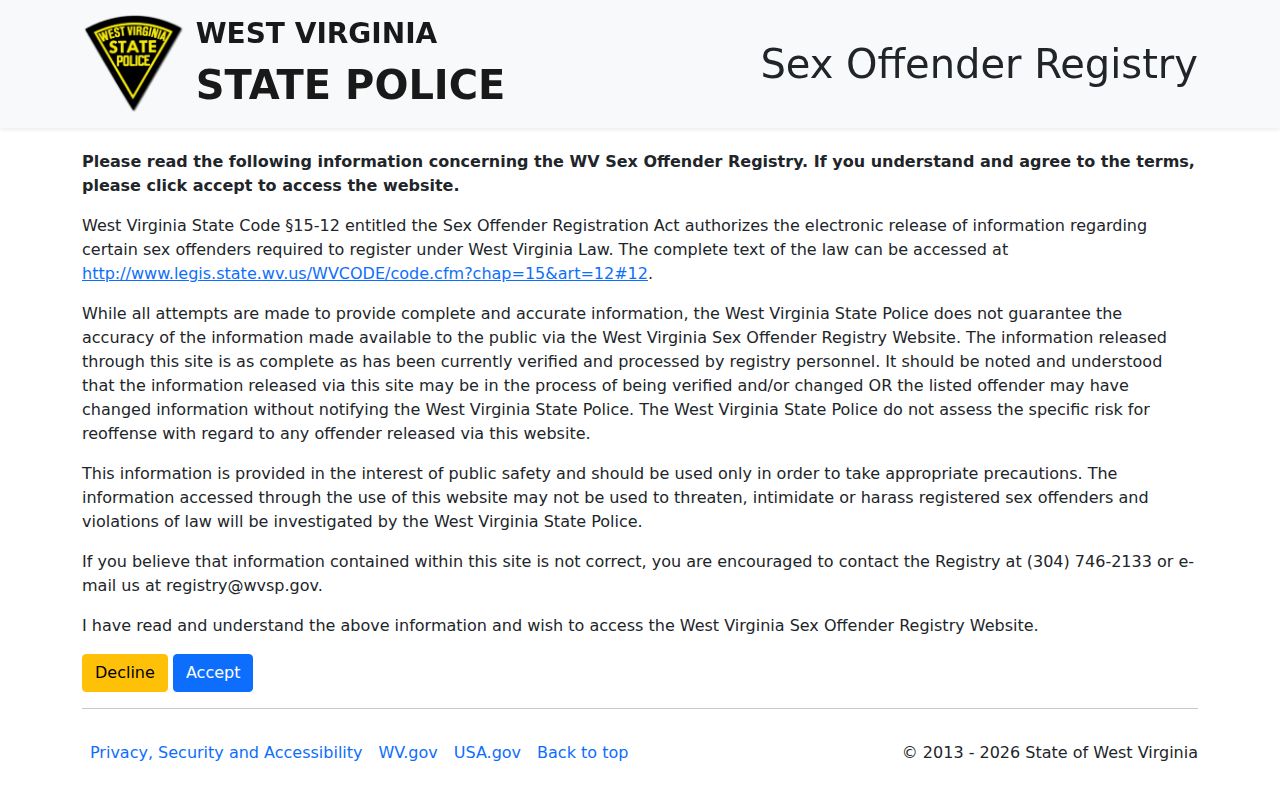
Use the current labels as displayed, since indexed copies did not reliably expose every advanced option.
Marion County Registry Is Not Risk Scoring
A frequent mistake is to treat a West Virginia registry entry as a score of future danger. WVSP expressly rejects that reading. The public system releases facts required by statute, but it does not assess the specific chance that a listed person will reoffend. Marion County residents should use the record for sensible awareness, verify the location and status, and avoid drawing conclusions the official profile does not support.
The same rule explains why federal tier labels should not be copied onto a West Virginia profile. State registration length turns on the offense and circumstances listed in Chapter 15, Article 12. It is not presented as a public Tier I, Tier II, or Tier III risk ladder.
Note: A registry listing is a statutory notification record, not a complete Marion County court file or an individualized safety forecast.
What a Registry Profile Shows
A public profile can combine identity, location, offense, conviction, registration, and verification facts. Availability depends on the particular record and what West Virginia law permits WVSP to release. Searchers should compare several fields before deciding that a result refers to the intended person. The public view is not a substitute for a certified court disposition, nor should its personal facts be copied into a private list or posted elsewhere.
| Name & Aliases | Primary registered name and any releasable aliases used to distinguish a person. |
|---|---|
| Photo & Physical Description | Photograph plus releasable sex, race, age or birth-related details, physical traits, and identifying marks when published. |
| Residence / Location | The registered residence or other location information that the statute permits the public to see. |
| Offense & Court | Qualifying offense, statute, conviction facts, and court information available for that registration. |
| Duration | Registration dates and the applicable ten-year or lifetime obligation, rather than a public risk tier. |
| Compliance / Verification | Registration status, verification information, and related public compliance facts when shown. |
The official profile layout demonstrates the types of fields a Marion County result may contain without requiring publication of a private registrant's identity.
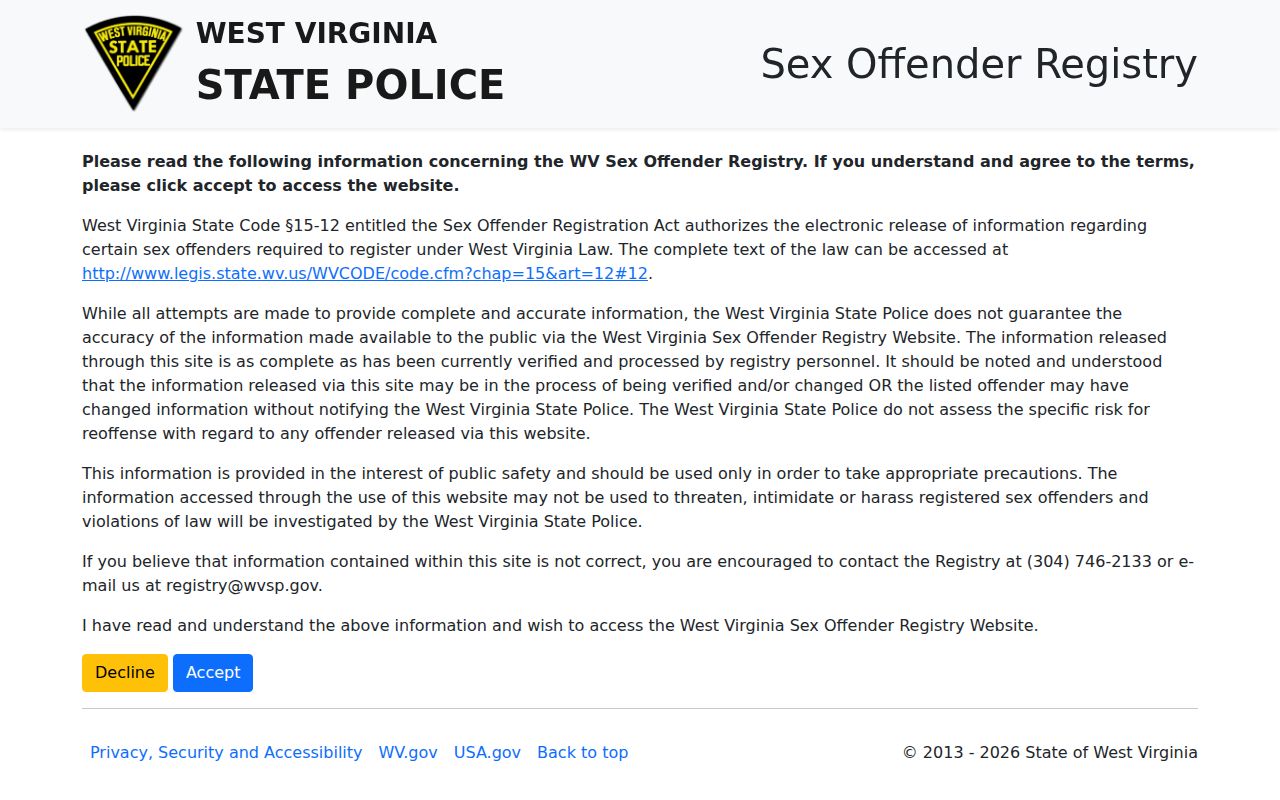
Read each field with its label and date, since an old address or pending verification can change what the entry means.
Correcting Marion County Registry Information
If a Marion County address appears wrong, do not confront the listed person or a household member. First recheck the profile and its verification details. Then send the concern to the WVSP Registry Unit at registry@wvsp.gov or call 304-746-2133. That same official contact accepts suspected noncompliance reports.
A mismatch does not by itself prove an offense under the registration law. The public page can lag while information is being checked, and a registrant may also have failed to report a change. WVSP and the detachment responsible for Marion County determine the proper verification or enforcement response. Knowing failures and false information can carry penalties under W. Va. Code §15-12-8, but the exact subsection and facts control.
Registration Requirements and Levels in West Virginia
West Virginia's public registry is organized around statutory categories and duties, not a three-level public risk scheme. Under §15-12-4, an ordinary qualifying registration lasts ten years from the applicable release from custody or mental facility, or from placement on probation, parole, supervised release, or conditional release. Lifetime registration applies in the circumstances named by the statute, including certain prior qualifying convictions, multiple victims or violations, sexually violent offenses, sexually violent predator findings, and specified cases involving minors or people perceived to be minors.
| Statutory Category | Duration | Verification |
|---|---|---|
| Ordinary qualifying registration | 10 years from the statutory starting event | Report in the birth month; WVSP verifies the address annually. |
| Prior qualifying conviction, multiple victims or violations, sexually violent offense or predator finding, and specified minor-related circumstances | Lifetime, subject to the exact language of §15-12-4 | Birth-month reporting; sexually violent predators also report in January, April, July, and October, with address checks every 90 days. |
The verification duties come from §15-12-10. A conviction that is later overturned can support the statutory process for removal. Because the outcome depends on the precise offense, history, and circumstance, a profile should never be relabeled with a tier that the West Virginia registry does not publish.
Marion County and the National Registry
The state portal is the direct source for West Virginia records. The National Sex Offender Public Website is useful when a safety question spans more than one state or when a person recently moved. NSOPW searches participating jurisdictions, but coverage and update timing vary. A national result should be confirmed with the jurisdiction that supplied it, and a missing national result should not overrule a current state record.
The official NSOPW search shows the cross-state layer available to Marion County families and community members.
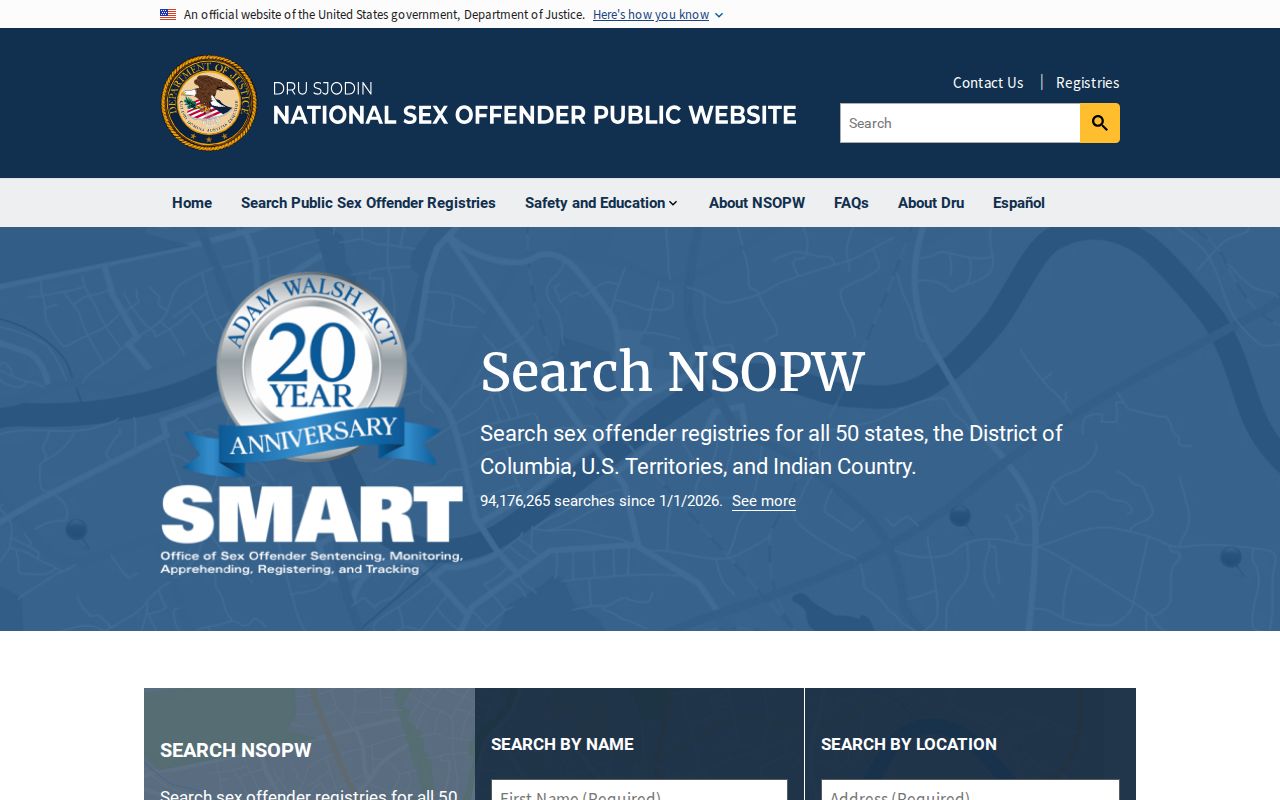
Use NSOPW for reach, then return to WVSP or another originating registry for the most direct profile and correction channel.
Marion County Registry Verification Cycle
Verification is an ongoing process. A ten-year registrant reports in the birth month, and WVSP verifies the address each year. A lifetime registrant also has birth-month duties. A person designated as a sexually violent predator has the added January, April, July, and October reporting schedule and an address verification every 90 days. These are reporting intervals, not risk ratings.
The WVSP detachment responsible for Marion County performs the local reporting and verification role. The county sheriff's general records counter is not documented as a separate public registry portal, and no Marion sheriff registry notification app was verified. Use the state system for public searches and the Registry Unit for an error or suspected failure to comply.
Lawful Use and Community Notification
Registry information supports personal, family, and community safety. A Marion County resident may use it to understand a nearby public listing, plan reasonable precautions, or confirm information through WVSP. It must not become a tool for threats, intimidation, harassment, or vigilante action. The official disclaimer warns that misuse can lead to investigation, while Chapter 15, Article 12 controls what WVSP releases and how registration duties are enforced.
Misuse can be a crime: Do not use West Virginia Sex Offender Registry information to threaten, intimidate, or harass a registrant or household. WVSP may investigate misuse under West Virginia law.
For questions about accuracy or noncompliance, use the WVSP Registry Unit phone or email rather than acting on a screenshot. Keep a note of the profile, the fact that appears wrong, and the date viewed. Do not republish a name, home address, plate, workplace, or other private identifier. A careful report gives the agency enough information to check the entry while protecting everyone involved.